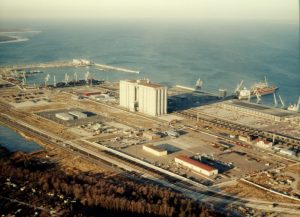
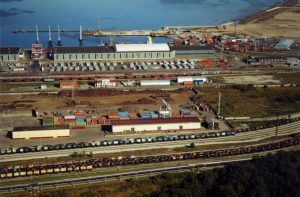
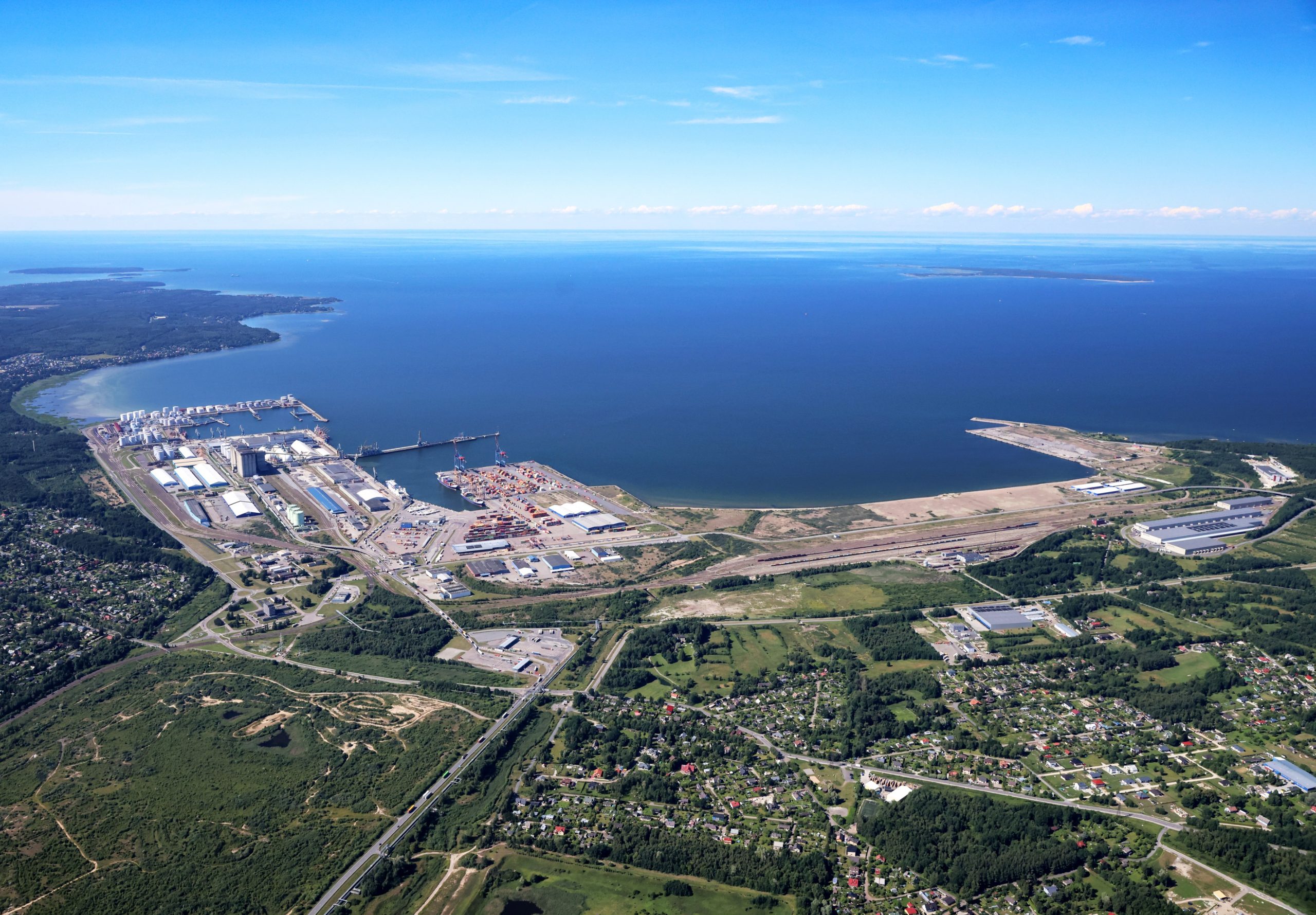
On 19 December 1986, Muuga Harbour opened its gates to the world. Originally known as Tallinn New Harbour, it was built to serve as a major gateway for imports into the Soviet Union, handling primarily grain and frozen food cargoes. Over the following decades, the port evolved into Estonia’s largest cargo harbour and one of the most important logistics hubs on the Baltic Sea.
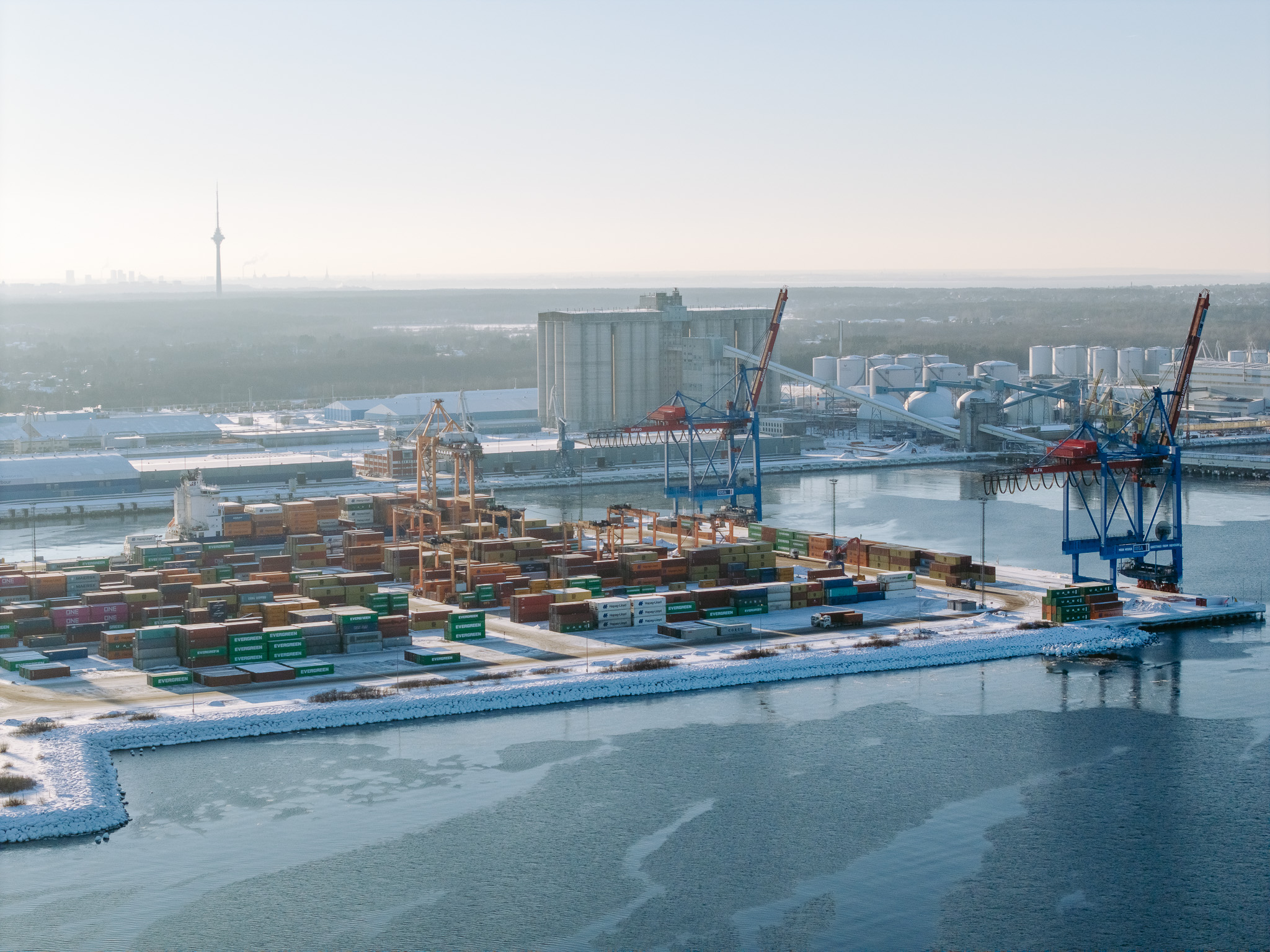
Opening of Muuga Harbour, 19 December 1986
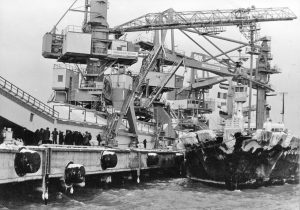
Signing of the handover and acceptance certificate for the port facility on 19 December 1986
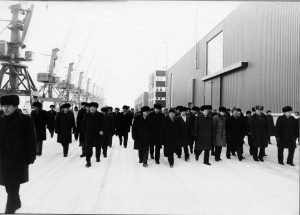
Visitors on the harbour pier
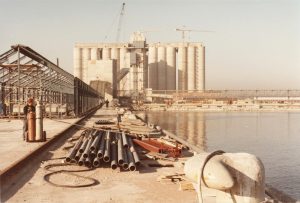
Visitors on pier 12
The story of Muuga’s development has been one of the continuous adaptations to a changing world. While the harbour’s first decades were defined by infrastructure construction and rapidly growing cargo volumes, the past decade has been shaped by new trade corridors, international investment, industrial development and preparations for integrating with future transport networks. It is particularly rewarding to note that many of the visions discussed when Muuga celebrated its 30th anniversary in 2016 have since become reality.
A new connection to Finland reshaped cargo flows
One of the most significant developments of the past decade was the launch of the Muuga–Vuosaari shipping route in 2017. The route was established as a deliberate effort to redirect freight traffic away from central Tallinn and provide companies with a faster and more efficient connection between Estonia and Finland.
Over the years, the Muuga–Vuosaari route has evolved into an important north-south freight corridor. The service has attracted new operators, and cargo volumes have steadily increased. In 2026, a contract was signed with TT-Line, bringing a new operator to the route and further reinforcing Muuga’s position as one of the most important gateways for trade between Estonia and Finland.
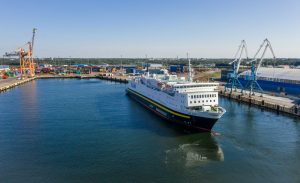
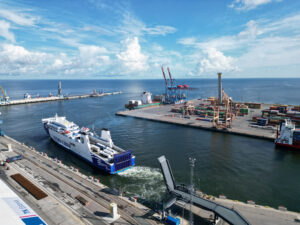
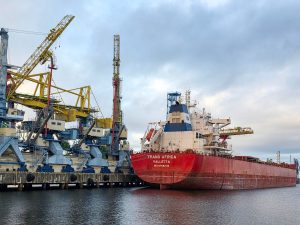
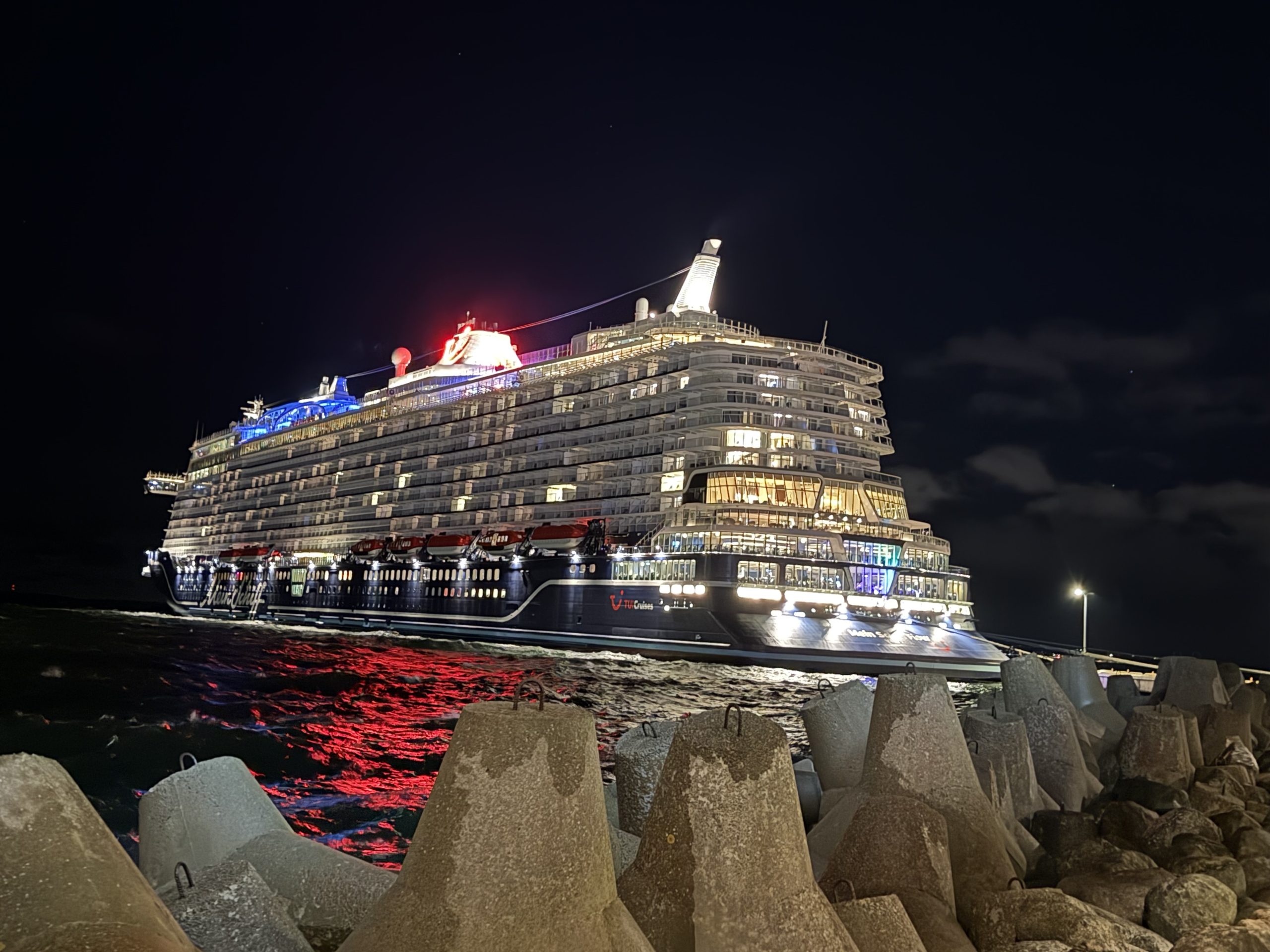
Tallink Sea Wind
Eckerö Line, Finbo Cargo
An international investor brought a new phase of growth
A landmark event for Muuga Harbour occurred in 2018 when HHLA, one of Germany’s leading port and logistics groups, acquired Transiidikeskus, the operator of Estonia’s largest container terminal. HHLA’s investment provided a major boost to the harbour’s development, extending far beyond a simple change of ownership. Estonia’s largest container terminal became part of one of Europe’s leading logistics networks, creating new opportunities for serving international cargo flows and increasing Muuga’s visibility on the European logistics map.
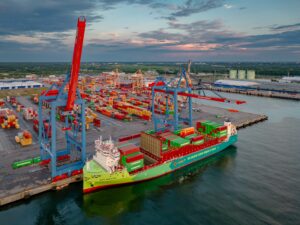
This new phase of development was symbolised by the arrival of the Alpha and Bravo container cranes, which entered service in 2022. As the largest container cranes in Estonia, they can handle the biggest container vessels operating in the Baltic Sea and significantly increased the terminal’s handling capacity. Their commissioning represented one of the largest investments made in Muuga’s container terminal in recent years.
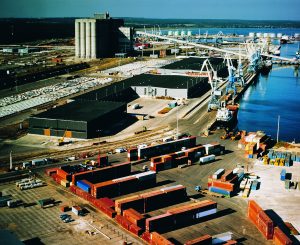
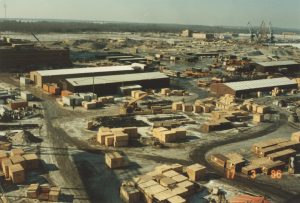
Container terminal 1999
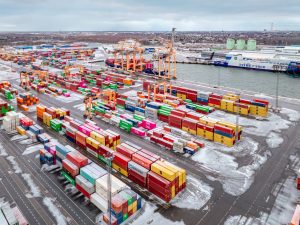
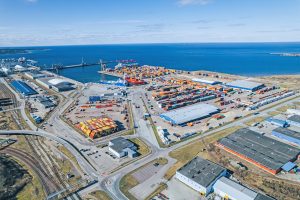
Container terminal 2025
Muuga Harbour as a multimodal logistics hub
Over the past decade, one of Muuga’s greatest strengths has become increasingly evident: its ability to connect different modes of transport. Sea, road and rail transport converge at the harbour, and in the future these connections will be further strengthened through direct access to the European rail network.
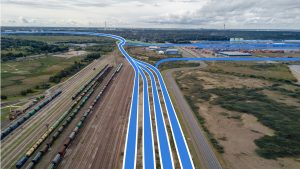
In 2020, work began on the design of the Rail Baltica Muuga freight terminal. The future terminal is set to become one of the most important logistics hubs along the Rail Baltica corridor, connecting the European standard-gauge railway, Estonia’s rail network and maritime transport.
The project has continued to advance step by step. In 2025, a design contract was signed for the future Rail Baltica connection to Muuga Harbour, and the necessary land acquisitions for the infrastructure project were completed. Once Rail Baltica becomes operational, Muuga will be one of the few ports in the region where cargo can move directly from ships onto the European rail network.
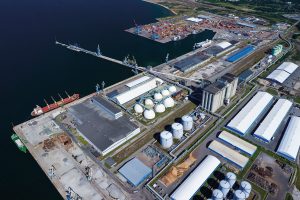
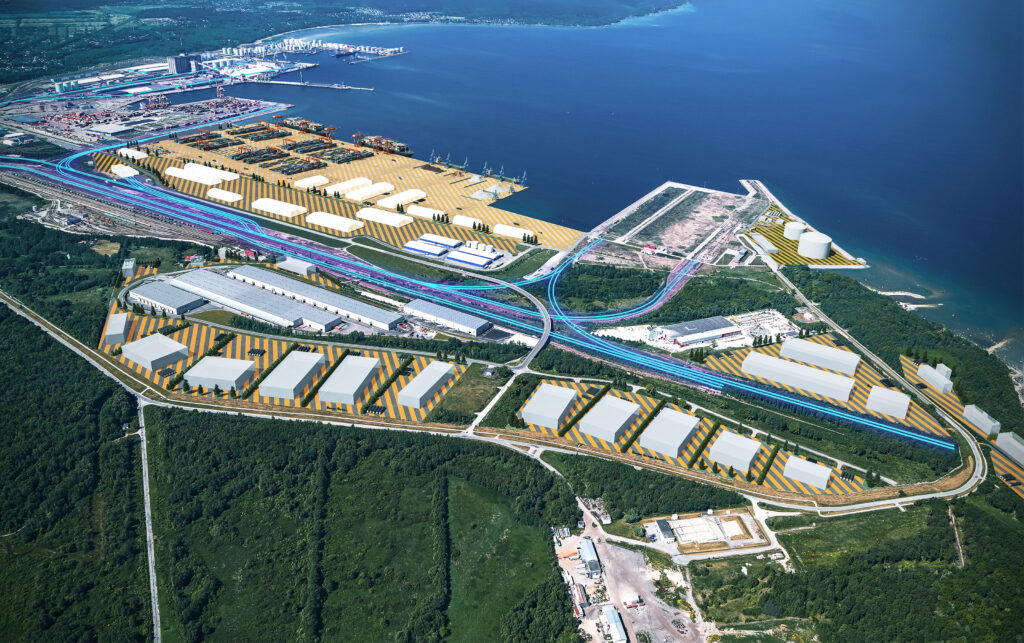
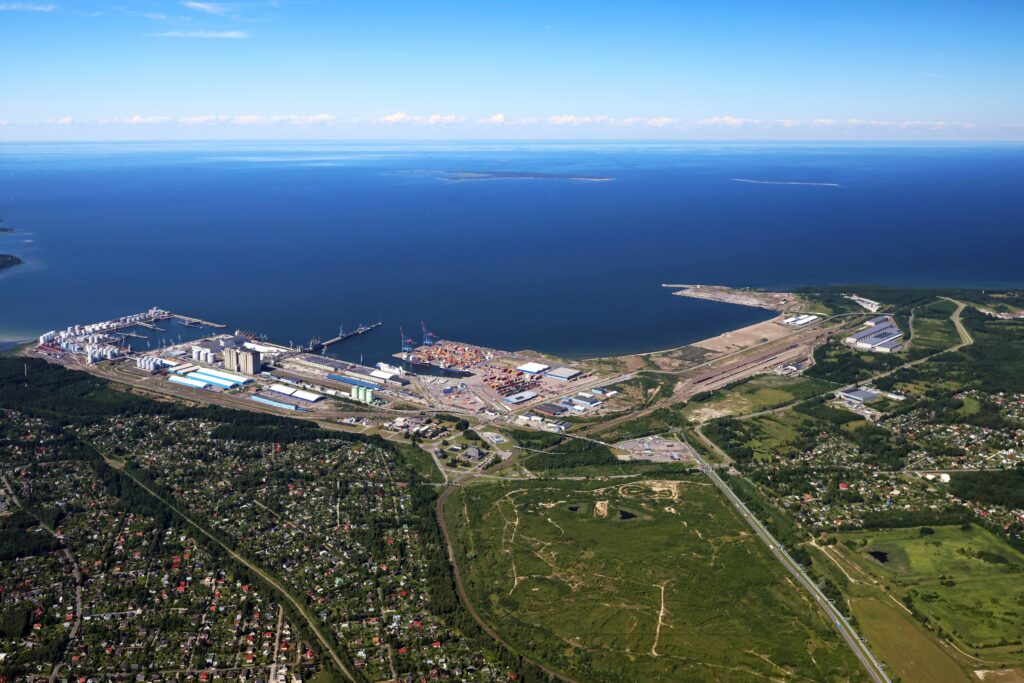
Muuga Harbour 2023
Rail Baltica route in Muuga Harbour
Industry moves closer to the port
Muuga’s development has long extended beyond its quays and terminals.
Over the past decade, the industrial park located within the port area has developed into one of Estonia’s most important destinations for industrial investment. Excellent transport connections, existing infrastructure and the ability to combine production, logistics and export operations make Muuga’s industrial areas attractive to both domestic and international investors.
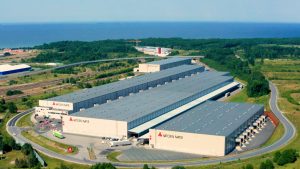
One of the most important anchor tenants has been the global logistics company Katoen Natie, which invested €10 million in expanding its Muuga logistics centre in 2021.
In recent years, PK Terminal has also expanded its operations, building new warehouses and handling facilities. In 2023, a new fertiliser storage complex was opened in cooperation with Yara, followed by the completion of a new 6,000-square-metre bulk cargo warehouse. Additional industrial projects are currently being planned, helping to increase the value created within the port area.
Today, the Muuga Industrial Park encompasses 76 hectares of development land, with the ambition of transforming Estonia’s largest cargo port into one of the country’s most important industrial areas as well.
Katoen Natie at Muuga Harbour
Estonia’s exports move through Muuga Harbour
Muuga Harbour’s importance for Estonian exporters has continued to grow.
One notable example is grain exports. In 2025, a vessel bound for Spain was loaded with 75,000 tonnes of wheat grown in Estonia, making it one of the largest grain shipments handled in recent years. Agricultural products cultivated by hundreds of Estonian farmers reach global markets through Muuga, and the harbour’s role as a gateway for Estonia’s agricultural exports continues to strengthen.
Looking to the future
The port is preparing for the completion of the Rail Baltica connection, continuing the expansion of its industrial park and creating new opportunities for innovative logistics solutions. Sustainability, innovation, and alternative energy solutions are also becoming increasingly important.
In 2024, a new container service was launched at Muuga using vessels powered by renewable methanol, and an agreement was signed for the development of a liquefied methane terminal. At the same time, terminal operators have invested in solar energy, electric cargo-handling equipment, and automated technologies.
In 2026, construction began on shore power connections for container and ro-ro vessels, while development of the Smart Port platform continues to make traffic flow management even more intelligent and efficient. Future priorities include expanding remote-control capabilities across various port operations, helping improve efficiency while reducing environmental impact.
These developments demonstrate that Muuga Harbour is a modern and continuously evolving logistics and industrial centre where international trade, industry, logistics and the transport solutions of the future come together.
Over the past forty years, Muuga Harbour has become much more than a port. It has grown into a vital pillar of Estonia’s economy and a gateway to the world through which goods, ideas and investments flow.
Vanasadama reisiterminalide juures on võimalik reisijate
pealevõtmiseks ja mahapanekuks lühiajaliselt tasuta parkida –
selleks on nii A- kui D-terminali juures Kiss&Sail parklad.
Kiss&Sail parklad on kasutamiseks nii erasõidukitele, mittelepingulistele
taksodele kui ka sõidujagamis-app’ide sõidukitele (Bolt, Uber, Yandex jne).
Otse terminali uste ette pääsevad vaid lepingulised taksod (Tallink, Tulika).
Terminalide ees on lubatud lühiajaliselt parkida ainult bussidel.
Cookie Consent
Kasutame küpsiseid veebilehe turvaliseks toimimiseks ja mugavamaks kasutamiseks. Vajalikud küpsised on alati aktiivsed. Analüütilisi küpsiseid kasutame ainult teie nõusolekul. Vaata meie küpsiste poliitikat.
Küpsiste seadistused
Muuda oma küpsiste seadistusi:
Essential cookies enable basic functions and are necessary for the proper function of the website.
Name
Description
Duration
Cookie Preferences
This cookie is used to store the user's cookie consent preferences.
30 days
CloudFlare provides web performance and security solutions, enhancing site speed and protecting against threats.
The cf_use_ob cookie informs Cloudflare to fetch the requested resource from the Always Online cache on the designated port. Applicable values are: 0, 80, and 443. The cf_ob_info and cf_use_ob cookies are persistent cookies that expire after 30 seconds.
session
__cfwaitingroom
The __cfwaitingroom cookie is only used to track visitors that access a waiting room enabled host and path combination for a zone. Visitors using a browser that does not accept cookies cannot visit the host and path combination while the waiting room is active.
session
cf_chl_rc_i
These cookies are for internal use which allows Cloudflare to identify production issues on clients.
session
cf_chl_rc_ni
These cookies are for internal use which allows Cloudflare to identify production issues on clients.
session
cf_chl_rc_m
These cookies are for internal use which allows Cloudflare to identify production issues on clients.
session
__cfruid
Used by the content network, Cloudflare, to identify trusted web traffic.
session
__cf_bm
Cloudflare's bot products identify and mitigate automated traffic to protect your site from bad bots. Cloudflare places the __cf_bm cookie on End User devices that access Customer sites that are protected by Bot Management or Bot Fight Mode. The __cf_bm cookie is necessary for the proper functioning of these bot solutions.
session
__cflb
When enabling session affinity with Cloudflare Load Balancer, Cloudflare sets a __cflb cookie with a unique value on the first response to the requesting client. Cloudflare routes future requests to the same origin, optimizing network resource usage. In the event of a failover, Cloudflare sets a new __cflb cookie to direct future requests to the failover pool.
session
_cfuvid
The _cfuvid cookie is only set when a site uses this option in a Rate Limiting Rule, and is only used to allow the Cloudflare WAF to distinguish individual users who share the same IP address.
session
cf_clearance
Whether a CAPTCHA or Javascript challenge has been solved.
session
__cfseq
Sequence rules uses cookies to track the order of requests a user has made and the time between requests and makes them available via Cloudflare Rules. This allows you to write rules that match valid or invalid sequences. The specific cookies used to validate sequences are called sequence cookies.
session
cf_ob_info
The cf_ob_info cookie provides information on: The HTTP Status Code returned by the origin web server. The Ray ID of the original failed request. The data center serving the traffic
session
These cookies are needed for adding comments on this website.
Name
Description
Duration
comment_author
Used to track the user across multiple sessions.
Session
comment_author_email
Used to track the user across multiple sessions.
Session
comment_author_url
Used to track the user across multiple sessions.
Session
WPForms is a user-friendly WordPress plugin for creating custom forms with drag-and-drop functionality.
Name
Description
Duration
wpfuuid
Used to track user interactions with forms.
11 years
Statistics cookies collect information anonymously. This information helps us understand how visitors use our website.
Google Analytics is a powerful tool that tracks and analyzes website traffic for informed marketing decisions.
Contains information related to marketing campaigns of the user. These are shared with Google AdWords / Google Ads when the Google Ads and Google Analytics accounts are linked together.
90 days
__utma
ID used to identify users and sessions
2 years after last activity
__utmt
Used to monitor number of Google Analytics server requests
10 minutes
__utmb
Used to distinguish new sessions and visits. This cookie is set when the GA.js javascript library is loaded and there is no existing __utmb cookie. The cookie is updated every time data is sent to the Google Analytics server.
30 minutes after last activity
__utmc
Used only with old Urchin versions of Google Analytics and not with GA.js. Was used to distinguish between new sessions and visits at the end of a session.
End of session (browser)
__utmz
Contains information about the traffic source or campaign that directed user to the website. The cookie is set when the GA.js javascript is loaded and updated when data is sent to the Google Anaytics server
6 months after last activity
__utmv
Contains custom information set by the web developer via the _setCustomVar method in Google Analytics. This cookie is updated every time new data is sent to the Google Analytics server.
2 years after last activity
__utmx
Used to determine whether a user is included in an A / B or Multivariate test.
18 months
_ga
ID used to identify users
2 years
_gali
Used by Google Analytics to determine which links on a page are being clicked
30 seconds
_ga_
ID used to identify users
2 years
_gid
ID used to identify users for 24 hours after last activity
24 hours
_gat
Used to monitor number of Google Analytics server requests when using Google Tag Manager
1 minute
Marketing cookies are used to follow visitors to websites. The intention is to show ads that are relevant and engaging to the individual user.
Facebook Pixel is a web analytics service that tracks and reports website traffic.